Production Delays and Missed Deadlines
Keeping up with delivery schedules is one of the most critical requirements of procurement.
There are many ways in which global supply chains will run into production delays, including:
- Raw material shortages
- Limited labor
- Equipment failures
- Capacity issues
- Ineffective supplier planning
Unless continually checked upon, suppliers could give their attention to other orders at your expense, leading to unexpected delays.
Lost sales and opportunities due to stock shortages and customer disappointment are critical issues for companies in the competitive US marketplace.
Proactive monitoring of production and supplier relationships is essential for the achievement of your objectives.
Lack of On-Ground Visibility
Distance-based procurement from thousands of miles away has a large visibility gap.
In many US companies the visibility of an item stops when the purchase order is submitted. Without an onsite, there is generally no visibility into:
- Production planning schedules
- Factory operation flow
- Factory staffing levels
- Inventory of raw materials and components
- Factory quality control operations
If there are problems that arise during the manufacturing process, buyers often have only learned of them when it is too late.
One of the primary problems in international procurement is a lack of visibility into the manufacturing progress. Difficulties in the manufacturing cycle, for example, issues with production scheduling, quality, or capacity, can go unnoticed until the shipment is due.
Procurement support can be provided from a local area to maintain supply chain visibility.
Quality Control Issues
Quality assurance is one of the biggest procurement concerns for US businesses purchasing from abroad.
Common issues are discrepancies between the sample approved and the final product production. Products may be fine as a sample, but production becomes inconsistent when dealing with large bulk orders.
Quality-related examples are:
- Substitute in materials
- Errors of manufacturing defects
- Mismatch in specifications
- Errors in packaging
- Non-compliance with standards
These quality-related issues result in customer dissatisfaction, returns of products, cost, and image loss.
Procurement efficiency requires inspection during the manufacturing processes and not after the products have been manufactured.
A reputable procurement firm in India could perform the inspections in the manufacturing process and eliminate and/or resolve the quality-related issues before the products are shipped.
Communication Barriers
A significant element of efficient purchasing operations is effective communication. However, international purchasing is often complicated by different languages, cultural values, and time zones, which lead to difficulties in establishing communication between buyers and suppliers. A number of communication problems have been often recorded as follows:
- misunderstanding of the specifications of the products
- delayed reply
- unreasonable expectations of order quantities
- execution of orders was incorrect
- misunderstanding of production processes
Even a slight inconsistency can lead to a costly mistake or delay. A well organized purchasing process has to maintain continuous communication with suppliers and buyers and also synchronize along the whole production process. Local buying teams contribute to eliminating these communication barriers and keep all interested parties informed.
Why Procurement Has Become More Complex
Today in our interlinked economy, procurement means much more than just buying goods & services. In the case of US companies, procurement has a direct influence on the operational efficiency, profitability of the business, supply chain viability, customer satisfaction, etc.
As companies begin to look outside their own countries for goods, components, raw materials, and finished goods, the problems of procurement take on diverse characteristics. Escalating costs, reliability of suppliers, quality controls, logistics disruptions, and communication barriers could all significantly hurt business results.
This is definitely true in terms of purchasing goods and components from emerging manufacturing bases, such as those in India. The great opportunities India has in areas such as manufacturing, engineering, textiles, chemicals, packaging, furniture, and a vast number of other categories could be undermined by the challenges of a remote purchase without adequate on-the-ground intelligence.
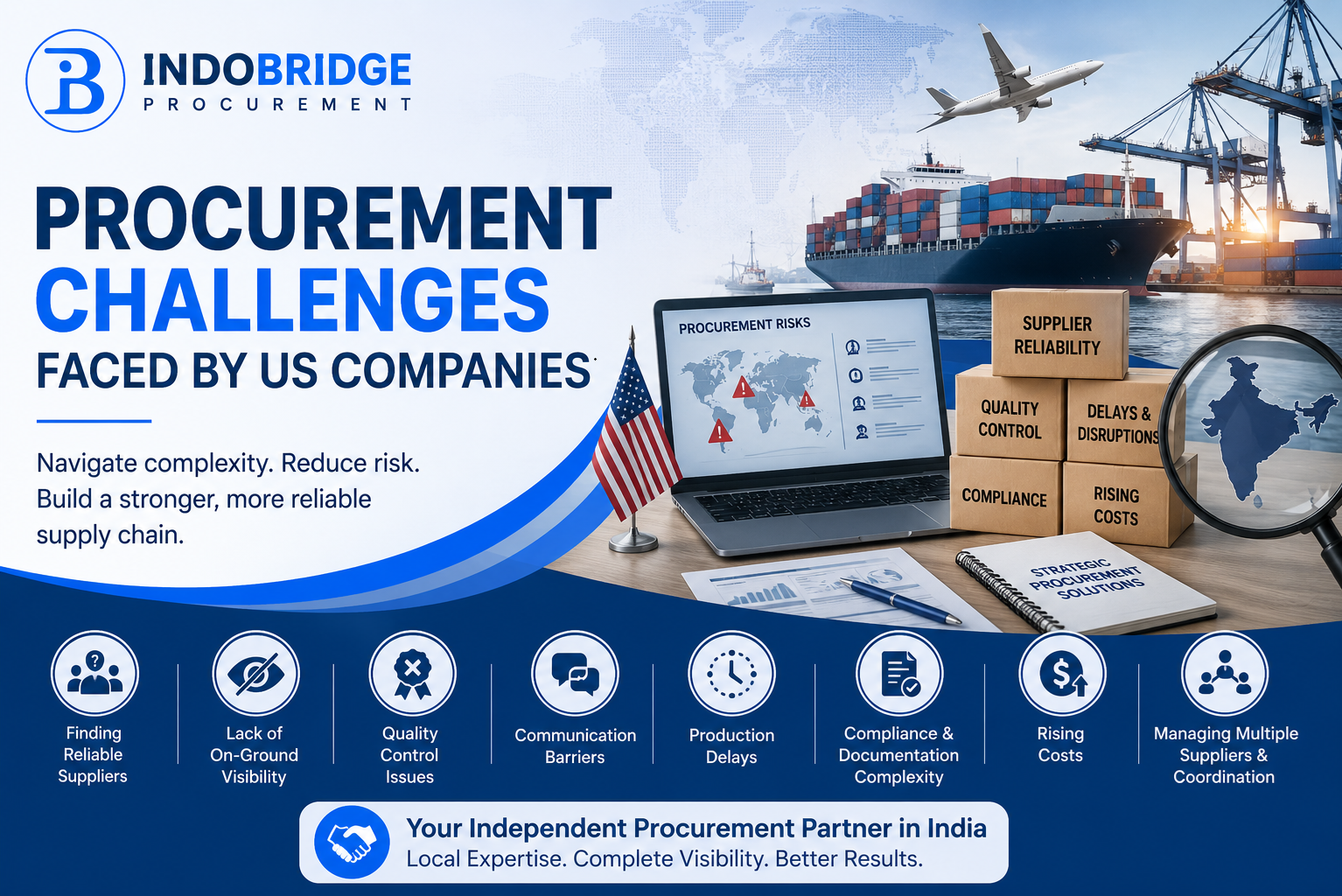
Here we will discuss what the typical challenges in procurement faced by US companies are and how a procurement company in India can be of great help to them.
Global sourcing offers a multitude of advantages, including access to lower costs, diverse supplier options, specialized manufacturing resources, and increased flexibility in the management of the supply chain. Businesses can purchase raw materials, goods, or components from all over the world in order to be more cost-efficient and streamline supply chain operation. However, there are also challenges and greater risks.
When purchasing internationally rather than locally, businesses are faced with many stages in sourcing, which all differ from one country to another, from laws to local customs, while managing a complex set of issues. Companies are obliged to deal with all aspects such as identifying and checking suppliers, ensuring quality standards, monitoring manufacturing, complying with specific legislation, handling export documents and transportation, and customs and logistics management. Besides, managing suppliers can be more challenging when dealing with cultural differences, language barriers, time differences, and communication issues.
Failure to control all of the sourcing operations can lead to minor issues such as production delays, quality failures, document errors, or shipping delays, all of which can affect delivery times, costs, and customer satisfaction. This is why businesses utilize procurement agents or partners with local sourcing capabilities to effectively manage global sourcing operations.
Finding Reliable Suppliers
Among all the procurement challenges in the US, finding reliable and competent suppliers can be the hardest one.
Most companies begin the supplier selection process with an online search on trade websites, directories, or sourcing platforms. Thousands of suppliers might show up on search results; however, it may be difficult to discern genuine manufacturers, traders, and middlemen.
The risks that most companies fall prey to are:
- Wrong company information
- Insufficient manufacturing facilities
- Hidden sub-contracting
- Sub-standard production quality
- Financial instability
The repercussions of an incorrect supplier choice can range from production issues to production delays to expensive business breakdown.
This is where an Indian procurement company can truly add value, providing the indispensable support of conducting supplier verifications, factory visits, and capability assessments prior to placing any purchase orders.
Compliance and Documentation Challenges
When you are doing international procurement, it is not just about production but also all the documentation and regulatory issues.
US importer normally gets challenged with the:
- Export documentation
- Customs related regulations
- Product certifications
- Labeling standards
- Country specific compliances
Typographical errors in paperwork can result in a shipping delay or custom penalties and cause extra expense.
Compliance is a vital function of procurement in today's world.
A reputable procurement firm in India can facilitate documentation and help lower the risks of making costly administrative mistakes.
Rising Costs and Price Volatility
Rising costs involved in procurement have become very difficult to manage, given global uncertainties with both the economy and inflation, volatile freight charges, and volatile commodity prices, which all directly contribute to an altered buying process and a complicated long-term cost strategy in buying internationally. Many importers of products to the U.S. market and other key markets find that costs have unexpectedly begun to exceed previous estimates due to rapidly shifting factors such as currency fluctuation, changing shipping and logistics fees, changing fuel prices, and supply chain disruption, as well as frequent increases from individual suppliers.
The principle in effective procurement, at the most basic level, is keeping up with market fluctuations and tracking price trends in addition to managing supplier contracts and relying on the knowledgeable resources of local purchasing professionals, who are connected to market changes; cultivate and manage close ties with their suppliers; know the local market conditions and business practices; anticipate market changes; minimize procurement risk; negotiate better prices; and receive the best commercial arrangements.
Managing Multi-Supplier Networks
As the business evolves and expands, it can start to procure from many suppliers based in different geographical locations.
Coordinating with numerous suppliers at once can give rise to issues such as:
- Coordination
- Communication
- Quality assurance and control
- Time scales
- Paperwork control
A decentralized procurement system will lead to procurement activities becoming very chaotic and uncontrollable.
Coordinated procurement activity ensures the business stays in control of supplier activity.
Limited Knowledge of Local Markets
Indian sourcing provides ample opportunities in fields like:
- Apparel and textiles
- Engineering and fabrication
- Auto components
- Packaging materials
- Furniture and home décor
- Chemicals and pharmaceuticals
- Building materials
- Diamonds
Yet, local knowledge is critical to succeeding in these markets.
Through engagement with a local procurement agency based in India, access to supplier bases, an understanding of industries, and on-the-ground support will be obtained, thereby improving the overall success of the sourcing exercise.
How Procurement Partners Help Solve These Challenges
A professional procurement partner offers a direct extension of your business in the sourcing country. Rather than monitoring and communicating with factories from a distance, companies can leverage localized expertise and operational support, which encompass:
- Supplier identification & sourcing
- Supplier validation & factory audits
- Product development & sampling
- Commercial negotiations
- Production supervision
- Quality control inspections
- Logistics arrangement
- Export document handling
The full approach of support brings risks down and makes the supply chain more transparent and efficient.
Conclusion
As global supply chains grow ever more complex, successful procurement has turned into a major competitive strength of U.S. businesses. Although there are great sourcing potential across all major sectors in India, difficulties are experienced due to remote suppliers in terms of supplier reliability, quality control, production delays, communication issues, compliance risks, etc.
For these reasons, many global buyers use a reliable procurement company in India to assist them all through the purchasing process in a local manner. This could span over every stage of the procurement: identifying and screening suppliers, managing and monitoring production progress, performing quality inspections, coordinating with logistics and shipping agents, and so on. A dedicated procurement agent can help achieve higher transparency and accountability in the buying process.
Indobridge Procurement acts as an offshore in-house procurement team for global buyers, which assists in managing suppliers in India, monitoring productions in Indian factories, controlling quality standards, and managing purchase operations effectively and safely.